
Localised cryotherapy and ice packs both use cold, but they are not the same experience.
An ice pack is a simple at-home option. You place something cold against the skin and leave it there for a period of time.
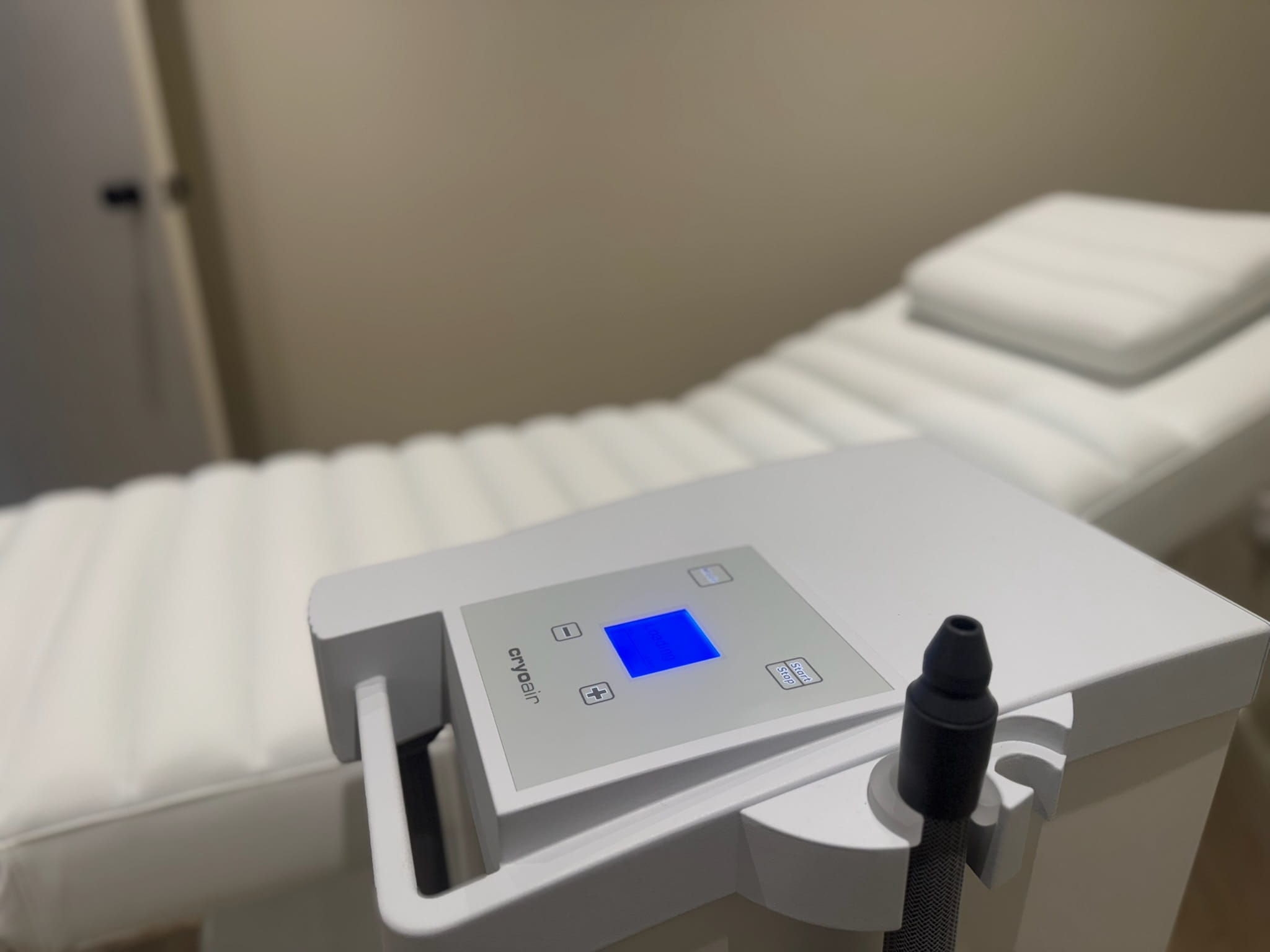
Localised cryotherapy is more structured and controlled. At Brysk, it uses directed cold air at around –32°C, applied to a specific joint, muscle, or smaller area of the body in a guided studio setting.
That difference changes how the cold is delivered, how controlled the session feels, how long it usually takes, and why someone might choose one option over the other.
At Brysk in Manchester, localised cryotherapy is delivered as a practical recovery session, not a medical treatment. It is designed for focused cold support when one area feels tighter, sorer, more irritated, or more worked than the rest.
Quick answer
Localised cryotherapy vs ice packs
Localised cryotherapy and ice packs are both forms of cold therapy, but they are used in different ways.
Ice packs are:
- Accessible
- Low-cost
- Easy to use at home
- Often used for simple, short-term cold application
Localised cryotherapy is:
- More targeted
- Guided by the Brysk team
- Delivered using directed cold air at around –32°C rather than static ice
- Often chosen when one specific area needs more focused attention
One is not automatically better for every person or every situation.
Ice packs may be enough for simple at-home cold application. Localised cryotherapy may make more sense if you want a shorter, more controlled, studio-based session for a specific area.
Below, we’ll break down how they differ, when each may make sense, and why cold should be used with clear expectations.
Jump to
2. What is localised cryotherapy?
3. What does an ice pack do?
4. Static ice vs cold air
5. What happens in the area?
6. Is it better?
7. Why ice packs are still used
8. Why cryotherapy feels structured
9. What the evidence says
10. Why duration matters
11. Comfort and convenience
12. When localised makes sense
13. When to avoid cold therapy
14. Which should you choose?
15. Summary
16. FAQs
17. Book in Manchester
Localised Cryotherapy vs Ice Packs: At a Glance
Before going deeper, it helps to compare the two side by side.
| Point of comparison | Localised Cryotherapy | Ice Pack |
|---|---|---|
| How cold is applied | Directed cold air at around –32°C applied to a specific area | Static cold pack placed against the skin |
| Setting | Guided studio session | Usually at home |
| Main benefit | Focused, controlled cold support | Simple, accessible cold application |
| Typical use | Specific joints, muscles, or recurring tight spots | Simple at-home cold application for minor, short-term issues |
| Temperature / delivery profile | Directed cold air at around –32°C applied to one area | Direct-contact cold from a static pack |
| Session feel | Cold, focused, guided | Cold, static, self-managed |
| Time commitment | Short, structured appointment | Usually longer application at home |
| Cost | Paid studio session | Low-cost home option |
| At Brysk | Guided appointment from £45, with cold application usually around 10–20 minutes | Not provided as a service |
Localised cryotherapy also uses a different temperature and delivery profile from an ice pack. At Brysk, that means directed cold air at around –32°C rather than direct-contact static ice. The aim is not simply to make the skin as cold as possible. The aim is to create a targeted cold stimulus in a controlled way.
Put simply, an ice pack is a basic at-home cold tool. Localised cryotherapy is a more controlled, guided way of applying cold to a specific area.
What Is Localised Cryotherapy?
Localised cryotherapy is targeted cold exposure for one specific part of the body.
Rather than stepping into a whole body cryotherapy chamber, the cold is applied directly to the area being treated. That might be a calf, knee, hamstring, lower back, shoulder, elbow, ankle, or another smaller area that feels tighter or more worked than usual.
At Brysk, localised cryotherapy uses directed cold air at around –32°C rather than an ice pack. The session is guided by the team, and the cold application is adjusted depending on the area being treated, sensitivity, and how the session feels.
It is usually chosen when the goal is more specific than full-body recovery.
For example:
- A runner may want focused support around a calf or knee
- A gym-goer may have one area that feels more worked after training
- Someone with a recurring tight spot may want a short, practical session
- A busy professional may want focused support without booking a full chamber session
Localised cryotherapy is not a medical treatment, and it does not replace physiotherapy, diagnosis, or rehab where those are needed. It is better understood as focused cold support delivered in a guided studio setting.
For a broader introduction to the treatment itself, you can also read our guide to what localised cryotherapy is and how it differs from whole body cryotherapy.
Watch: What localised cryotherapy looks like
Nathan explains how localised cryotherapy is applied at Brysk, including how directed cold air is used for a specific area rather than the whole body.
What Does an Ice Pack Do?
An ice pack is one of the simplest forms of cold therapy.
It usually involves placing a cold pack, gel pack, or wrapped ice pack against the skin for a set period of time. This makes it a cheap, familiar, and easy-to-access option for at-home cold application.
It is commonly used when someone wants simple cold application for a minor area of soreness, swelling, or discomfort.
The main difference is that an ice pack is static. Once applied, it sits in one place. The person using it controls the time, pressure, positioning, and how long it stays on the skin.
That can be useful for simple at-home use, but it also means the experience is less guided and less controlled than a studio-based localised cryotherapy session.
How Ice Packs Affect the Area Being Cooled
From a physiological point of view, an ice pack works by cooling the skin and underlying tissues through direct contact. This can reduce local blood flow for a period of time through vasoconstriction and may temporarily dull sensation in the area. That is why ice is often used when an area feels sore, swollen, irritated, or freshly aggravated.
The limitation is control. Because the cold source stays in direct contact with the skin, the experience depends heavily on how cold the pack is, whether it is wrapped properly, how much pressure is applied, and how long it is left in place. Used carefully, it can be useful. Used for too long or without enough protection, it can become uncomfortable, overly numbing, or harsh on the skin.
The Main Difference: Static Ice vs Guided Cold Air
The biggest difference is how the cold is delivered.
An ice pack is passive. It relies on direct contact between the cold pack and the skin.
The cooling happens gradually and depends on things like:
- How cold the pack is
- How long it is applied for
- Whether it is wrapped correctly
- How much pressure is applied
- How often it is moved or removed
Localised cryotherapy is more active and targeted. Instead of placing a frozen object against the skin, directed cold air at around –32°C is applied to the chosen area in a controlled way.
Ice packs can also feel harsher on the skin because the cold is static and direct-contact. If they are left on too long or used without enough protection, the sensation can become sharp, uncomfortable, or almost burning.
The session feels more focused, and the person delivering it can adjust how the cold is applied. At Brysk, that means the area, comfort level, and purpose of the session are all considered before and during the appointment.
This is why localised cryotherapy may appeal when someone wants cold applied with more control, guidance, and precision than at-home icing can usually offer.
What Happens in the Area Being Cooled?
When cold is applied to a specific area, the body responds quickly.
As covered above, blood vessels near the skin surface can temporarily narrow as part of the body’s normal cold response. The aim is to create a short, focused cold stimulus in the area being worked on, rather than simply making the skin as cold as possible for as long as possible.
As the area naturally warms again after the session, circulation changes through vasodilation. This cold-to-warm response is one reason localised cryotherapy is often used when an area feels tight, overworked, irritated, or more noticeable than usual.
Cold can also affect local sensation. In simple terms, cooling the area may temporarily change how strongly discomfort or irritation is felt, which helps explain why some people describe the area as feeling calmer, fresher, looser, or easier to move afterwards.
The delivery method matters too. An ice pack creates direct-contact cold that stays in one place. Localised cryotherapy uses directed cold air at around –32°C, which can be adjusted and controlled during the session. That makes the experience feel more gradual and targeted, rather than static or harsh.
The difference is not just “cold versus cold”. It is how the cold is delivered, how controlled the application feels, how well the session is matched to the area being treated, and how sensibly the exposure is managed.
Is Localised Cryotherapy Better Than an Ice Pack?
Not automatically.
Localised cryotherapy may feel more targeted, guided, and controlled than an ice pack, but that does not mean it is always the better choice in every situation.
An ice pack may be enough if:
- You want simple at-home cold application
- The area is minor and short-term
- You do not need a guided session
- Cost and convenience matter most
- You are following advice from a healthcare professional
Localised cryotherapy may make more sense if:
- You want a shorter, more focused cold session
- One specific joint or muscle needs attention
- You prefer the cold to be applied by someone else
- You want a studio-based recovery option
- You are already building a wider recovery routine
The better question is what you need from the cold application: immediate at-home access, or a more guided and structured session.
The value is not that localised cryotherapy replaces ice entirely. The value is that it offers a more guided, controlled option when self-managed icing feels too basic, awkward, or imprecise.
Why Ice Packs Are Still Used
Ice packs are still popular because they are immediate, familiar, and easy to use at home.
If you tweak a calf after a run, finish a football match feeling sore, or notice a knee flaring up during the evening, an ice pack is something you can usually apply straight away without travelling anywhere or booking an appointment.
They are also:
- Cheap
- Easy to find
- Simple to use
- Accessible at home
- Useful for quick short-term cooling
In simple, short-term situations, that convenience can matter more than anything else.
If you have been advised to use ice by a physio, GP, or another qualified professional, that advice should take priority over a general wellness article.
Brysk’s position is not that ice packs are useless. They are a basic cold application tool, and for some situations, that may be exactly what is needed.
The main limitation is that they are self-managed. That means the person using them has to decide where to apply the pack, how long to leave it there, and when to stop.
That is where localised cryotherapy feels different: the cold is delivered in a guided setting with a clearer structure around the session.
Why Localised Cryotherapy Feels More Structured
Localised cryotherapy may appeal when someone wants targeted cold support without managing the session themselves.
At Brysk, the team confirms the area being treated, talks you through the session, and applies the cold in a calm, supervised setting.
If you’re new to cryotherapy more generally, our guide to what happens before, during and after cryotherapy at Brysk explains how guided sessions are approached from start to finish.
Compared with an ice pack, localised cryotherapy feels more structured because:
- Directed cold air at around –32°C is applied to the target area
- The session is guided by the team
- The application can be adjusted during the session
- You are not guessing how long to leave ice on the area
- The appointment fits into a wider recovery environment
It is still cold, and it still needs to be used sensibly. The difference is that the session is guided rather than self-managed.
What the Evidence Says About Cold Therapy
Cold application has a long history in recovery, sport, and rehabilitation settings. But the evidence is mixed, and context matters.
A 2004 systematic review on ice for acute soft-tissue injuries found limited evidence for some outcomes and called for more high-quality research. A later review discussing traditional cold therapy and gaseous cryotherapy also noted that cold therapy can have a place, particularly in certain acute injury contexts, but that evidence across different cryotherapy methods remains mixed.
That makes the comparison more nuanced than simply saying localised cryotherapy is better than ice, or that cold therapy does not work. Cold application may be useful in certain contexts, but method, duration, purpose, and individual situation all matter.
That is why Brysk presents localised cryotherapy as focused recovery support, not injury treatment, diagnosis, or a guaranteed fix.
Want cold support for one specific area?
If an ice pack feels too basic, awkward, or hard to judge, cryotherapy gives you a guided way to apply cold to one focused area in a calm studio setting.
Duration Matters: More Cold Is Not Always Better
One of the biggest risks with at-home icing is assuming that longer must be better.
That is not always the case.
With any form of cold exposure, dose matters. Duration, temperature, area treated, and individual response all influence how useful the session is.
A 2019 systematic review looking at cryotherapy duration in athletes found that protocol matters, and that longer icing times may have short-term negative effects on muscle power and activity.
That does not mean ice packs or localised cryotherapy should be avoided. It means cold should be used with a clear purpose rather than treated as something to push indefinitely.
At Brysk, the same principle applies across both whole body cryotherapy and localised cryotherapy: use the right session for the right reason, and avoid chasing intensity for its own sake.
If you want more detail on that wider principle, we’ve also covered why cryotherapy session length matters.
Localised Cryotherapy vs Ice Packs for Comfort and Convenience
Ice packs are more immediate. You can usually grab one at home, apply it quickly, and avoid travelling anywhere or booking an appointment.
That immediacy is useful after a run, match, gym session, or minor flare-up when you want simple cold application straight away.
The trade-off is that ice packs can feel awkward. They may be wet, difficult to position, hard to keep in place, uncomfortable if left too long, or inconvenient around work, training, or daily life.
Localised cryotherapy is less immediate because it requires a studio appointment. But once you arrive, the session is structured and guided for you. You are not preparing ice, wrapping it, timing it yourself, holding it in place, or wondering whether you have done enough.
So the better option depends on what kind of convenience matters most at that moment: immediate at-home access, or a more structured, hands-off recovery session.
When Might Localised Cryotherapy Make More Sense?
Localised cryotherapy may make more sense when the area feels specific.
For example, it may appeal if:
- One calf feels tight after running
- A knee feels more worked during a training block
- A hamstring feels more noticeable after lower-body work
- A shoulder feels stiff after a busy week
- A lower back area feels like it needs focused attention
- You want a guided cold session rather than at-home icing
It may also appeal if you are already visiting Brysk for other recovery sessions and want to add something more targeted.
For example, some clients may combine localised cryotherapy with:
- Whole body cryotherapy for broader cold exposure
- Compression boots when the lower body feels heavy
- Red light therapy when they want a calmer, low-impact recovery session
The point is not to stack treatments for the sake of it. It is to choose the session that matches the goal.
When Should You Avoid Localised Cryotherapy or Ice Packs?
Cold should not be applied to every area or in every situation.
You should avoid or seek advice before using cold application over areas with:
- Open wounds
- Active infection
- Impaired sensation
- Recent surgical sites
- Active deep vein thrombosis
- Skin that is broken, highly sensitive, or not responding normally
You should also seek appropriate medical guidance if the pain is persistent, worsening, unexplained, or linked to a clear injury.
At Brysk, localised cryotherapy is not a substitute for:
- Physiotherapy
- Medical diagnosis
- Imaging
- Rehabilitation
- Treatment for an injury or condition
A cold session may help an area feel different in the short term, but feeling different is not the same thing as being fixed.
That distinction is important.
Localised Cryotherapy vs Ice Packs: Which Should You Choose?
A simple way to decide is to ask what you need from the cold application.
Choose an ice pack if:
- You want a low-cost home option
- The area is minor and short-term
- You are following professional advice
- You do not need a guided session
- You want something immediately available
Choose localised cryotherapy if:
- You want targeted cold support in a studio setting
- One specific joint or muscle needs attention
- You want the session to be guided
- You prefer not to self-manage the timing or application
- You are building recovery into a wider routine
Neither option is automatically better for everyone.
Ice packs are simple and accessible. Localised cryotherapy is more structured and guided.
The right choice depends on the situation, the area being treated, and how much support you want around the session.
So, What’s the Difference?
Localised cryotherapy and ice packs both use cold, but they are different tools.
An ice pack is a simple at-home option. It is low-cost, accessible, and often enough for basic cold application.
Localised cryotherapy is a guided cold-air session for a specific area. It is usually chosen when someone wants a more focused, structured, and studio-based approach.
At Brysk, localised cryotherapy in Manchester is delivered as a guided appointment from £45, with cold application usually lasting around 10–20 minutes depending on the area, sensitivity and concern.
It is not a medical treatment, not a shortcut to healing, and not a replacement for proper diagnosis or rehab where that is needed.
For the right person, at the right time, localised cryotherapy can be a useful targeted recovery session – especially when one area feels like it needs more attention than the rest.
FAQs
If you’re comparing localised cryotherapy with ice packs, these are the practical questions people usually ask before deciding which option makes sense.
Is localised cryotherapy better than an ice pack?
Not always. Localised cryotherapy is more guided, targeted, and studio-based, while ice packs are cheaper and easier to use at home. The better choice depends on the situation and what kind of support you want.
What is the difference between localised cryotherapy and an ice pack?
An ice pack is a static cold object placed against the skin. Localised cryotherapy uses directed cold air at around –32°C, applied to a specific area in a guided session.
Is an ice pack a type of cryotherapy?
In the broadest sense, yes. Cryotherapy simply means using cold. However, when people search for localised cryotherapy in a wellness or recovery studio context, they are usually referring to targeted cold air applied through a device, not a basic ice pack.
Does localised cryotherapy get colder than an ice pack?
At Brysk, localised cryotherapy uses directed cold air at around –32°C applied to the target area. However, the number itself is less important than how the cold is delivered, how long it is applied for, and whether the session is appropriate for the person and area being treated.
Is localised cryotherapy safer than ice?
Not automatically. Both need to be used sensibly. Localised cryotherapy at Brysk is guided and delivered in a supervised studio setting, while ice packs are usually self-managed at home.
Can localised cryotherapy help an injury?
Localised cryotherapy may be used around areas that feel sore, stiff, irritated, or overworked, but it is not an injury treatment and should not replace physiotherapy, diagnosis, or medical advice.
When is an ice pack enough?
An ice pack may be enough when the area is minor, short-term, and you simply want low-cost cold application at home. If the issue is persistent, worsening, or linked to an injury, it should be assessed properly.
Does localised cryotherapy hurt?
Many clients describe it as very cold and focused, but manageable. At Brysk, the session is guided throughout.
How long does localised cryotherapy take at Brysk?
Localised cryotherapy at Brysk is delivered within a guided appointment, with the cold application usually lasting around 10–20 minutes depending on the area being treated.
How much does localised cryotherapy cost at Brysk?
A single localised cryotherapy appointment at Brysk is £45. Packages and memberships are also available for regular use.
Where can I try localised cryotherapy in Manchester?
Brysk offers localised cryotherapy in Manchester city centre, just off St Ann’s Square and behind Barton Arcade.
Book Localised Cryotherapy in Manchester
If one specific area feels tighter, sorer, or more worked than the rest, localised cryotherapy may be a practical option to consider.
Brysk offers guided localised cryotherapy appointments in Manchester city centre from £45, delivered in a calm, supervised studio setting.
For people using localised cryotherapy more regularly, packs and memberships may offer better value than booking one-off sessions each time.
Want focused cold support for one specific area?
Book a session or speak to the team if you’d like help choosing whether localised cryotherapy makes sense.
References
- Jinnah AH, Luo TD, Mendias C, Freehill M. Cryotherapy duration is critical in short-term recovery of athletes: a systematic review. Journal of ISAKOS. 2019;4(3):131–136.
- Wang ZR, Ni GX. Is it time to put traditional cold therapy in rehabilitation of soft-tissue injuries out to pasture? World Journal of Clinical Cases. 2021;9(17):4116–4122.
- Bleakley C, McDonough S, MacAuley D. The use of ice in the treatment of acute soft-tissue injury: a systematic review of randomized controlled trials. The American Journal of Sports Medicine. 2004;32(1):251–261.