
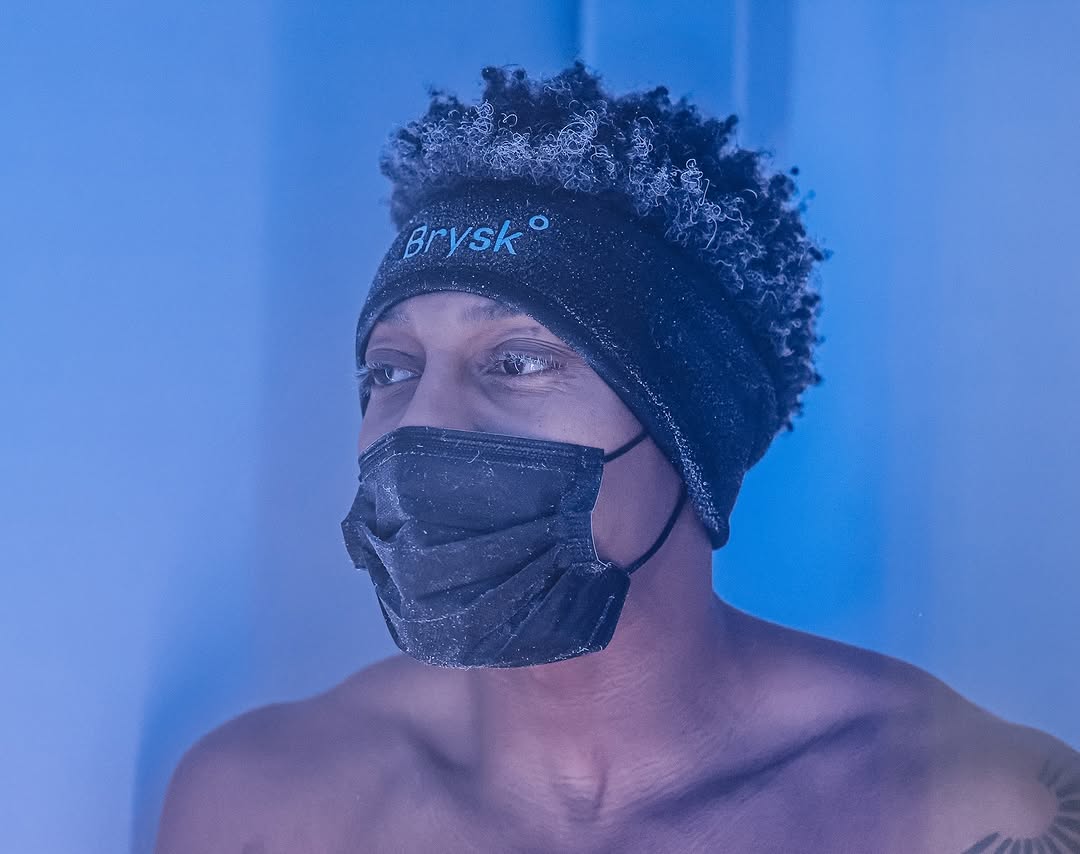
If you are comparing cryotherapy studios, one of the most important things to know is that not all cryotherapy chambers work in the same way.
The biggest difference is simple: in an electric chamber, your whole body goes into the cold environment, including your head. In a liquid nitrogen chamber, your body goes in but your head stays out. That changes how the cold is delivered, how evenly it reaches the body, and how the session tends to feel.
A lot of people also want to know how cold each type of chamber actually gets, but the number alone never tells the full story.
So this is not really a question of which setup has the most dramatic number on paper. It is a question of which type of cryotherapy experience is likely to feel better for you.
At Brysk, whole body cryotherapy is delivered using an electric chamber because it supports a more even, full-body, response-led session that feels clearer, more controlled, and easier to trust from the start.
Key takeaways
- Electric and liquid nitrogen cryotherapy chambers are not the same experience
- In an electric chamber, your head is inside the cold environment too; in a liquid nitrogen chamber, it stays outside
- Electric chambers cool the air mechanically, creating a more even chamber environment
- Liquid nitrogen chambers use gas, which can create a more variable cooling pattern
- Liquid nitrogen chambers are still common because they are widely used and often have a lower setup cost for studios
- Electric and liquid nitrogen chambers often sit in different temperature brackets, but colder on paper does not automatically mean better in practice
- Brysk uses an electric cryotherapy chamber because it supports a fuller-body, more controlled, safety-first style of delivery
Jump to
2. How cold are they?
3. Side-by-side comparison
4. Full-body vs head-out
5. How they create cold
6. How the session feels
7. What the science suggests
8. Electric pros and trade-offs
9. Nitrogen pros and trade-offs
10. Why colder isn’t always better
11. Why Brysk chose electric
12. Which suits you?
13. FAQs
14. Better experience?
15. References
Electric vs liquid nitrogen cryotherapy: quick answer
If you want the short version, electric cryotherapy often makes more sense if you value a full-body experience, more even cooling, and a session that feels calmer and more controlled.
Liquid nitrogen cryotherapy can still be a valid option, and many studios use it, but it is a meaningfully different setup. Your head stays outside the chamber, the cold is created using nitrogen gas, and the overall experience tends to feel less like stepping into a full-body cold room and more like a head-out cold exposure.
So if your real question is, “Which one is likely to feel better for me to actually try?”, the answer usually comes down to what kind of experience you want.
If you want cryotherapy that feels more full-body, more consistent, and easier to trust from the first session, electric has a strong case.
That does not mean liquid nitrogen cannot be effective. It means the setup is different, and that difference is worth understanding before you book.
How cold are electric and liquid nitrogen cryotherapy chambers?
This is one of the most common questions people ask when comparing chamber types.
- Electric full-body cryotherapy chambers often sit somewhere in the high minus-80s to minus-110°C
- Liquid nitrogen cryotherapy chambers often advertise colder-looking numbers, sometimes around minus-120°C to minus-160°C
- Brysk’s electric cryotherapy chamber operates at –87°C
- That does not make chamber temperature a straight like-for-like comparison
- How the cold is created and delivered matters just as much as the number itself
Electric chambers create a controlled cold-air environment that the whole body steps into. Liquid nitrogen chambers use gas and usually keep the head outside. So while nitrogen setups can sound colder on paper, that does not automatically mean they create a fuller-body, more even, or better-controlled cryotherapy experience.
At Brysk, temperature matters, but delivery matters more. Brysk’s cryotherapy model is built around short, supervised, response-led sessions rather than dramatic temperature marketing.
Electric vs liquid nitrogen cryotherapy chambers: side-by-side comparison
Before you decide which setup is likely to feel better, it helps to see the differences side by side.
| Point of comparison | Electric cryotherapy chamber | Liquid nitrogen cryotherapy chamber |
|---|---|---|
| Body exposure | Full-body, including the head | Partial-body, with the head outside |
| How the cold is created | Electrically cooled chamber air | Nitrogen gas creates the cold environment |
| Typical advertised temperature range | Often around the high minus-80s to minus-110°C | Often advertised at colder-looking ranges, sometimes around minus-120°C to minus-160°C |
| What you breathe during the session | Normal chamber air | Head remains outside because the chamber uses gas |
| Cooling pattern | More even across the body | Can feel more variable or patchy |
| Session feel | More enclosed, full-body, and controlled | More abrupt, head-out, and gas-based |
| Why some studios choose it | Better control and full-body delivery | Lower setup cost, with a lower barrier to entry for studios |
| Main trade-off | Higher equipment and running costs | Head-out format and a cooling pattern that may feel less even across the body |
That is the key point: you are not just comparing equipment. You are comparing two different types of cryotherapy experience.
The biggest difference: electric cryotherapy is full-body, while liquid nitrogen is head-out
This is the part that matters most.
In an electric cryotherapy chamber, your whole body goes into the cold environment, including your head. The chamber air has already been cooled, so when you step in, you are stepping into a full-body cold space.
In a liquid nitrogen chamber, your body is inside the unit but your head stays above it. That is because the cold is being created by nitrogen gas, so the setup is designed to keep the head out.
That changes more than the look of the chamber. It changes the kind of cold exposure you are actually stepping into.
A true full-body chamber gives the body a broader cold stimulus from the moment the session begins. That matters because cryotherapy is not just about a patch of skin feeling cold. It is about how the whole session is experienced.
At Brysk, this is one of the biggest differences people comment on after trying both. Even when a nitrogen setup sounds colder on paper, some clients say the electric chamber feels colder overall. Brysk treats that as lived experience rather than proof of a superior physiological effect, but it fits with the idea that a true full-body, more even cold environment can feel more complete and immersive.
It is worth being precise on the science here. Research comparing whole-body and partial-body cryostimulation suggests both can trigger acute autonomic nervous system effects, with a shift towards parasympathetic activity. It also suggests that head exposure itself may not be the main factor driving that response when skin cooling is matched.
So the safest conclusion is not that head-in exposure automatically creates a superior neurological outcome. It is that full-body and head-out setups are different experiences, and they should not be treated as interchangeable.
Watch: What is whole body cryotherapy?
Nathan explains what whole body cryotherapy involves at Brysk, including how the session works and what to expect inside the chamber.
How electric and liquid nitrogen chambers create cold differently
An electric chamber cools the chamber air mechanically. In practice, that means the cold environment is already there before you enter. The chamber is designed to maintain a controlled cold-air space that you step into and out of freely.
A liquid nitrogen chamber works differently. The cold is created using nitrogen gas, and the setup relies on that gas to lower the temperature around the body while the head remains outside.
That is also why headline temperature comparisons can be misleading if you do not also look at how the cold is actually being delivered.
That difference matters for two main reasons.
- First, electric cryotherapy gives Brysk more control over the chamber environment. The cold is part of the chamber itself, rather than being created by introducing gas into the unit. Brysk’s internal delivery principles are explicit that electric systems were chosen for more consistent and even cooling, greater control over delivery variables, and reduced risk compared with gas-based systems.
- Second, the way nitrogen is delivered can create a less uniform cooling pattern. That is one of the reasons liquid nitrogen chambers can advertise a dramatic temperature number while still creating a less even experience overall. Your body does not just react to the headline number. It reacts to how the cold is actually reaching you.
So while both systems expose the body to extreme cold, they do not create the same chamber environment.
What that means for how the session actually feels
This is where the difference starts to matter in a real-world way.
If the cooling is more even across the body, the session is more likely to feel steady and consistent from start to finish. If the cooling is more variable, the session can feel harsher, patchier, or less predictable.
That matters because cryotherapy is not only about how cold the air is. It is also about how the body experiences that cold exposure overall.
Brysk often hears from people who have tried both chamber types that the electric chamber feels colder overall, even when the nitrogen setup advertises a more extreme temperature. That may sound counterintuitive, but it makes more sense when you separate intensity from uniformity.
In practice, the difference usually shows up like this:
- A more even cooling pattern may feel steadier across the body
- A head-out setup may feel more partial or less immersive
- A dramatic temperature number does not automatically mean a stronger overall cryotherapy experience
- How the cold is delivered matters just as much as the number attached to it
Cold exposure can influence autonomic activity, and recent review-level evidence suggests cryostimulation can enhance parasympathetic nervous activity overall. What the evidence does not clearly prove is that head exposure on its own is the main reason one setup is neurologically better than the other.
So the practical takeaway is not that electric is “scientifically superior” in every physiological respect. It is that Brysk believes full-body, more even cooling creates a better overall cryotherapy experience to step into and tolerate well.
If you also want a clearer idea of what happens before, during and after cryotherapy, Brysk has broken that down step by step as well.
What the science most clearly suggests
The science here is still evolving, but a few points are especially useful when comparing these two chamber types without oversimplifying them.
- Cryostimulation can influence autonomic nervous system activity
- Both whole-body and partial-body cryostimulation can produce acute physiological effects
- Head exposure may not be the main factor driving autonomic change on its own
- The size and uniformity of the cold stimulus still seem to matter to how the session feels in practice
That is why visual cooling patterns are worth paying attention to, even though they are not a direct like-for-like comparison of chamber temperature.
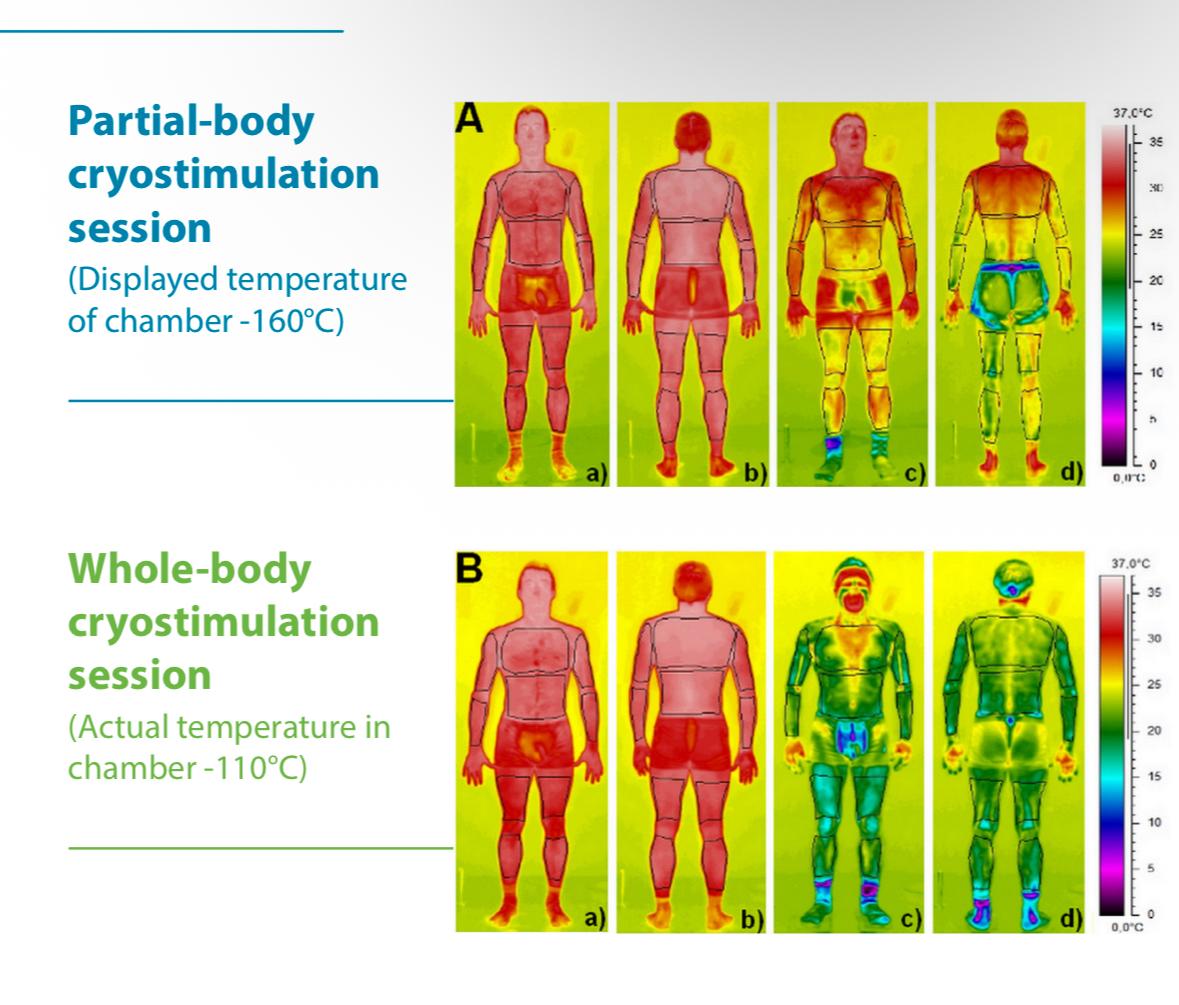
Illustrative thermal comparison showing broader, more even cooling in a whole-body setup than in a partial-body setup. This image is included to show the difference in cooling pattern, not to reflect Brysk’s exact chamber temperature or claim a like-for-like temperature comparison.
Looking for whole body cryotherapy in Manchester city centre?
If you are comparing cryotherapy options and want to understand how Brysk’s electric chamber setup fits into the bigger picture, the team can talk you through it before you book.
Electric cryotherapy: main pros and trade-offs
If you are weighing up electric cryotherapy, the main appeal is not just that it sounds more advanced. It is that the session tends to feel more full-body, more even, and more controlled from start to finish.
That said, no setup is perfect. Electric chambers also come with trade-offs, especially behind the scenes.
Main pros
The strongest advantages of electric cryotherapy usually come back to five things:
- Full-body exposure – Your head is included in the chamber environment, so the session feels like a true whole-body experience.
- More even cooling – Electric chambers create a more homogeneous cold-air environment. That matters because the cold tends to feel more consistent across the body rather than harsher in some areas and lighter in others.
- No gas-based chamber environment – Because the chamber is electrically cooled, you are standing in a cold-air environment rather than a gas-based setup. That removes the oxygen displacement consideration that comes with nitrogen-based systems.
- Greater delivery control – The chamber environment can be managed more precisely, and the session can be paused or stopped immediately if needed. Brysk’s cryotherapy model is built around full supervision, clear stop points, and adjusting delivery based on the body’s response rather than pushing preset extremes.
- Better fit for a response-led session – Brysk treats cryotherapy as a short, measured exposure guided by surface skin temperature response, not a tolerance test. Electric systems fit that approach better.
Trade-offs
The trade-offs are mostly practical rather than user-facing:
- Higher setup and running costs – Electric chambers are more expensive to buy and run, which is one reason electric cryotherapy can be priced a little higher.
- They are still very cold – Electric cryotherapy may feel more controlled, but it is still a serious cold exposure and should still be approached with the same respect, screening, and supervision as any other cryotherapy session.
- More complex machinery behind the scenes – Electric systems are more advanced and more operationally demanding, even if that complexity works in the client’s favour during the session.
Liquid nitrogen cryotherapy: main pros and trade-offs
Liquid nitrogen chambers are still widely used, and that is not by accident. They have some genuine practical advantages, especially for operators. But they also come with limitations that matter more once you understand how the session is actually delivered.
Main pros
The main strengths of liquid nitrogen chambers are usually:
- Common market option – Liquid nitrogen chambers have been around a long time and are widely used in the cryotherapy industry.
- Lower setup cost – They are typically cheaper to buy initially than electric systems, which lowers the barrier to entry for many studios.
That cost difference is one reason chamber type can influence pricing too, which Brysk has broken down further in what you’re actually paying for in a cryotherapy session.
- Commercial flexibility for some operators – They can still make commercial sense for studios that prefer a lower upfront equipment commitment, even if the longer-term cost picture depends heavily on nitrogen supply and usage.
In practice, some operators see liquid nitrogen as cheaper to set up, but not always as straightforward to run over time, because supply pricing and ongoing usage can leave them dependent on external nitrogen providers.
- Can advertise very dramatic temperature numbers – On paper, liquid nitrogen setups can sound extremely cold, which can appeal to people who assume colder always means stronger.
Trade-offs
The main trade-offs tend to be:
- Head stays outside the chamber – This is the biggest one. However it is marketed, a liquid nitrogen chamber is not the same as stepping into a fully enclosed whole-body electric chamber.
- Cooling can feel less even – Because nitrogen gas is being used to create the cold environment, cooling can be more variable across the body.
- Gas-based safety considerations – Nitrogen systems come with gas handling, storage, and ventilation considerations that simply do not apply in the same way to an electrically cooled chamber. That does not make every nitrogen chamber unsafe by default, but it does mean the setup brings a different safety context that depends heavily on proper handling, environment, and supervision.
If safety is one of the main things you are weighing up, it also helps to read more about whether cryotherapy is safe and what a properly supervised session should look like.
- Can feel harsher or less controlled – Because the setup is different, the experience can feel more abrupt and less calm than a fully enclosed electric chamber.
- Start temperature and felt effect are not always what the headline suggests – One of the interesting points in Brysk’s notes is that nitrogen sessions do not always begin at the dramatic final target temperature people imagine. The user experience can therefore feel less immediate and less seamless than the headline number implies.
Why colder on paper does not always mean better
This is one of the biggest misunderstandings in cryotherapy, especially when people compare chamber temperatures without comparing chamber design.
It is easy to see a very extreme number and assume that chamber must be better. But the number alone does not tell you:
- Whether the cooling is full-body or head-out
- How even the cold exposure is
- How the session begins
- How controlled the chamber environment feels
- How the body actually experiences that cold
That is why Brysk does not treat temperature as a performance metric in its own right. Its internal cryotherapy principles make that explicit: how cold is delivered matters more than how cold it gets.
A colder-sounding temperature can still be attached to a less even, less immersive, and less controlled experience.
That is why the better question is not “which chamber sounds colder?” but “which setup gives you the better cryotherapy experience?”
That is also why Brysk does not treat cryotherapy like an endurance challenge. Why cryotherapy session length matters explains that side of delivery in more detail.
Why Brysk chose an electric cryotherapy chamber
Brysk chose an electric cryotherapy chamber because it better fits the kind of cryotherapy experience the studio wants to deliver.
For Brysk, that comes down to five things:
- Full-body rather than head-out
- More even and controlled delivery
- Supervised rather than self-directed
- Response-led rather than endurance-led
- Clear and reassuring rather than gimmicky
This choice also fits the wider Brysk approach. Brysk is positioned as a calm, science-led wellness and recovery studio, not a medical clinic and not a macho “push your limits” brand. Its content and safety documents repeatedly emphasise careful delivery, screening, supervision, and long-term trust over hype.
So when Brysk says it prefers electric cryotherapy, it is not just a technical preference. It is a judgement about what creates the better overall session for the kind of people Brysk serves: athletes, runners, busy professionals, first-timers, and anyone who wants recovery to feel structured, well explained, and easier to trust.
That also fits Brysk’s wider cryotherapy protocol, where sessions are guided by response rather than by pushing time or intensity for its own sake.
Which type of cryotherapy chamber is likely to suit you better?
If you are mainly trying to work out which chamber is likely to feel like the better option for you, this is the simplest way to think about it.
Electric is likely to make more sense for you if you want:
- A true full-body cryotherapy experience
- A setup that feels more even and controlled
- A session that feels clearer and more reassuring first time
- A chamber that fits a safety-first, response-led approach
- A provider that cares more about delivery quality than dramatic temperature marketing
Liquid nitrogen may still appeal if:
- Price is your main priority
- Local availability matters more than chamber type
- You are less concerned about the head-out setup
- You are comfortable with a more traditional gas-based cryotherapy format
By Brysk’s standards, electric is the better fit. Not because nitrogen should be dismissed outright, but because electric cryotherapy supports the kind of experience Brysk believes is stronger, safer, and more convincing in real life.
FAQs
Once you realise electric and liquid nitrogen cryotherapy are not the same setup, these are the questions that usually come next.
What is the difference between an electric cryotherapy chamber and a liquid nitrogen chamber?
An electric cryotherapy chamber cools the chamber air mechanically and creates a full-body cold environment, including the head. A liquid nitrogen chamber uses nitrogen gas to create the cold and keeps the head outside the unit.
Is electric cryotherapy better than liquid nitrogen cryotherapy?
If you value a fuller-body, more even, more controlled cryotherapy experience, electric has a strong advantage. Brysk prefers electric because it better fits a guided, response-led, safety-first approach to cryotherapy.
Is liquid nitrogen cryotherapy still whole-body cryotherapy?
Not in the same sense as an electric chamber. Your body is exposed to the cold, but your head stays outside, so the experience is partial-body rather than a fully enclosed whole-body cold environment.
Why do liquid nitrogen chambers often sound colder on paper?
They can advertise very extreme temperature numbers, but that does not automatically mean the cold is being delivered more evenly or that the session will feel better overall.
How cold is an electric cryotherapy chamber compared with a liquid nitrogen chamber?
Electric full-body cryotherapy chambers often sit somewhere around the high minus-80s to minus-110°C, while liquid nitrogen chambers often advertise colder-looking numbers. Brysk’s electric cryotherapy chamber operates at –87°C. But those figures are not a straight like-for-like comparison, because electric and nitrogen systems create and deliver cold differently.
Why do some people say electric cryotherapy feels colder anyway?
Because a full-body, more even cold environment can create a stronger overall felt effect than a more variable head-out setup, even if the nitrogen chamber advertises a more extreme temperature number.
Why do some studios still use liquid nitrogen cryotherapy?
Liquid nitrogen chambers are common in the market and often have a lower setup cost than electric systems, which makes them a more accessible commercial option for many studios. Longer-term running costs can be more variable depending on nitrogen supply and usage.
Is electric cryotherapy safer than liquid nitrogen cryotherapy?
No chamber type makes a session safe on its own. Safe cryotherapy still depends on screening, supervision, protective gear, and sensible limits. That said, Brysk sees electric cryotherapy as the better fit for its safety-first model because it avoids a gas-based chamber environment and allows for more controlled delivery.
What type of cryotherapy chamber does Brysk use?
Brysk uses an electrically cooled whole body cryotherapy chamber in Manchester city centre. Its cryotherapy sessions are brief, supervised, and built around clear session limits and post-session checks.

So, which type of cryotherapy chamber is the better experience?
If you are comparing electric and liquid nitrogen cryotherapy, the real takeaway is simple: chamber type changes more than the headline temperature.
It changes whether the session is full-body or head-out. It changes how evenly the cold is delivered. It changes how the experience feels while you are inside it. And it changes whether the setup feels calm, controlled, and easier to trust, or simply more dramatic on paper.
For Brysk, electric cryotherapy is the better choice because it supports a fuller-body, more even, more carefully delivered experience. That fits the way Brysk believes cryotherapy should be done: clearly explained, closely supervised, and built around the body’s response rather than intensity for its own sake.
If you are thinking about trying whole body cryotherapy and want to understand whether Brysk’s electric cryo chamber in Manchester feels like the right fit for you, the team can talk you through it before you book.
Want a bit of guidance before you start?
Book a session or speak to the team if you’d like help choosing what feels right.
References
Louis J, Schaal K, Bieuzen F, Le Meur Y, Filliard J-R, Volondat M, et al. Head Exposure to Cold during Whole-Body Cryostimulation: Influence on Thermal Response and Autonomic Modulation. PLOS ONE. 2015;10(4):e0124776.
Zalewski P, Bitner A, Słomko J, Szrajda J, Klawe JJ, Tafil-Klawe M, et al. Whole-body cryostimulation increases parasympathetic outflow and decreases core body temperature. Journal of Thermal Biology. 2014;45:75–80.